
- Blog
- Virtual Medical Receptionist
What Does a Virtual Medical Receptionist Do? A Look Behind the Front Desk

Table of Contents
Your receptionist is checking in a patient when the phone rings.
The patient on the phone wants to reschedule. Another patient is waiting at the front desk. Someone else has left a voicemail asking about an appointment.
You already know what a receptionist does.
The more interesting question is: what happens when that receptionist isn’t physically sitting at your front desk?
That’s where a virtual medical receptionist comes in.
A virtual medical receptionist is a real person who works remotely but performs many of the same front-desk functions your practice relies on every day. This includes answering patient calls, scheduling appointments, handling intake, updating records, sending reminders, routing messages and following your practice’s specific procedures.
The important part isn’t simply that they’re “virtual.”
It’s how they become part of your existing workflow.
Definition
What Is a Virtual Medical Receptionist?
A virtual medical receptionist is a remote healthcare professional who handles administrative and front-desk communication for a medical practice.
They can answer incoming calls, schedule and reschedule appointments, confirm visits, collect patient information, handle routine questions, route calls, coordinate messages and perform other administrative tasks based on the practice’s needs.
But unlike a traditional answering service, a medical virtual receptionist can become involved in what happens after the phone is answered.
For example, instead of simply taking a message that says, “John wants to schedule an appointment,” they may be able to access the appropriate scheduling system, find an available appointment based on your practice’s rules and book it.
Workflow
How Does a Virtual Medical Receptionist Actually Work?
For a healthcare provider, this is probably the more important question.
You don’t necessarily need to know how the technology behind call routing works. What matters is what happens when your phone rings.
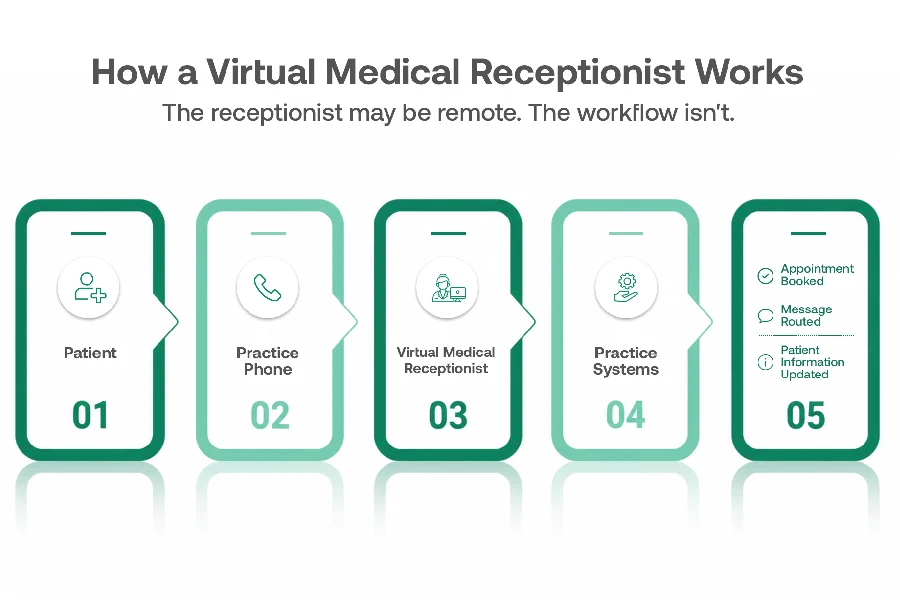
Think of the process like this:
Patient calls your practice → call reaches the virtual receptionist → receptionist identifies the reason for the call → accesses the appropriate practice system → completes the task or routes it → updates the necessary information.
From the patient’s perspective, they’re simply calling your medical office.
The receptionist answers according to your practice’s instructions, follows your scheduling and communication protocols, and knows when a call needs to be transferred or escalated.
That means a virtual medical receptionist isn’t operating in isolation. They’re working as an extension of your front desk.
Responsibilities
What Does a Virtual Medical Receptionist Do?
The exact responsibilities depend on your practice and the level of support you need, but a virtual medical receptionist can handle a broad range of front-office tasks.
1. Patient calls and communication
They can answer incoming calls, identify why a patient is calling, provide approved administrative information, take and route messages, transfer calls and follow your practice’s communication procedures.
This can be particularly valuable during the times when your in-office staff is already busy with patients.
2. Appointment scheduling
Scheduling is one of the most common responsibilities of a virtual medical receptionist.
They can schedule new-patient appointments, reschedule existing visits, process cancellations, confirm appointments and manage waitlists.
The important distinction is that they’re not simply looking for an empty space on the calendar. A properly trained receptionist follows your scheduling rules.
For example, if new patients require 30 minutes, established patients require 15 minutes and certain appointment types can only be scheduled with a particular provider, the receptionist follows those instructions.
3. Patient intake and information updates
A medical virtual receptionist can collect information from new patients, provide registration or intake instructions, update demographic information and make sure the appropriate administrative details are recorded.
This helps reduce the amount of information your in-office team has to collect while a patient is standing at the front desk.
4. Insurance and referral-related tasks
Depending on the scope of the role, virtual receptionists can also assist with administrative insurance verification, referral coordination and related patient communications.
The important distinction is that these tasks should follow your practice’s established procedures and the receptionist’s authorized responsibilities.
This helps reduce the amount of information your in-office team has to collect while a patient is standing at the front desk.
5. Appointment reminders and follow-ups
A receptionist can contact patients about upcoming appointments, confirmations, cancellations, recalls or other administrative follow-ups.
This gives your practice another way to stay connected with patients without requiring your clinical staff to spend time making routine calls.
5. EHR and administrative updates
A virtual receptionist healthcare may also work within your EHR or practice-management system to update appointment information, document administrative interactions and keep patient records current, depending on the access and permissions provided by the practice.
In other words, “virtual” doesn’t have to mean “disconnected from your systems.
Real Example
What Happens When a Patient Actually Calls?
Let’s make this practical.
Imagine a new patient calls your practice at 10:15 AM.
The patient says:
“I’d like to make an appointment.”
The receptionist doesn’t simply write down the patient’s name and ask someone to call them back.
Instead, the workflow might look like this:
1. The call is answered.
The receptionist identifies the practice and asks how they can help.
2. The reason for the call is identified.
It’s a new-patient appointment.
3. Required information is collected.
The receptionist gathers the information your practice requires for scheduling and intake.
4. The appropriate schedule is checked.
They look at the available appointments in the practice’s scheduling system.
5. Your scheduling rules are followed.
They select an appropriate appointment based on provider, appointment type, duration and any other instructions you’ve established
6. Appointment is booked and confirmed
The patient receives the appropriate confirmation or next-step instructions — and the interaction is documented.
That’s what providers often miss when they hear the term “virtual receptionist.” The value isn’t simply that someone picked up the phone. The value is that the call can move toward a resolution without automatically becoming another task for your in-office team.
Important Distinction
What If a Patient Asks a Medical Question?
This is where a healthcare receptionist is different from a generic customer-service representative.
A virtual medical receptionist should know the difference between an administrative question and a clinical question.
A patient might ask:
“What time does the office close?”
That’s administrative.
But:
“I’ve been having chest pain. Should I come in tomorrow?”
is not something a receptionist should answer based on their own judgment.
Instead, the receptionist follows the practice’s established escalation procedure—routing the patient to the appropriate clinical staff or following whatever urgent-call protocol the practice has established.
They don’t diagnose the patient. They don’t prescribe treatment. They don’t improvise medical advice. Their job is to keep the administrative side moving while knowing when something needs to be handed to the clinical team.
System Access
Can a Virtual Medical Receptionist Use Your EHR?
In many setups, yes.
This is often one of the first questions a provider has:
“If they’re not in my office, how are they going to schedule patients?”
A virtual medical receptionist can work within the practice’s approved systems, including an EHR or practice-management system, when appropriate access has been provided.
The goal isn’t to make you learn another complicated platform.
It’s generally the opposite.
Your receptionist should learn the systems your practice already uses and the workflow you’ve already established.
That may include scheduling appointments, updating patient information, documenting administrative interactions or handling other front-desk functions within the permissions you’ve provided.
Access should be limited to what the receptionist needs to perform their role, with appropriate privacy and security procedures in place.
Key Distinction
Virtual Medical Receptionist vs. Answering Service
These terms are sometimes used interchangeably, but they don’t necessarily mean the same thing.
An answering service might answer your phone and take a message:
“Dr. Smith’s office, how can I help?”
“John wants to schedule an appointment.”
“I’ll pass along the message.”
Your team then has to call John back.
A virtual medical receptionist can potentially take the interaction further:
“I’d be happy to help you schedule that. Let me check Dr. Smith’s availability.”
They check the appropriate system, schedule the appointment according to your practice’s rules and provide the patient with the next steps.
An answering service primarily handles the call. A virtual medical receptionist can handle the front-desk workflow behind the call.
The exact capabilities depend on the service and the access you provide, but that’s an important distinction when evaluating your options.
Getting Started
What Does Your Practice Need to Do?
Probably less than you think.
You don’t need to become an IT expert to work with a virtual medical receptionist.
The important part is making sure the receptionist understands how your practice operates.
That includes things like:
- How you schedule different appointment types
- Which providers handle which patients
- What information needs to be collected
- Which calls should be transferred
- What questions can be answered administratively
- When a clinical issue needs escalation
- How patient messages should be documented
- Which systems the receptionist will use
Once those workflows are established, the receptionist can follow them consistently.
That’s why the quality of the receptionist matters just as much as the technology connecting them to your practice.
So, What Does a Virtual Medical Receptionist Really Do?
At first glance, the answer seems simple:
They answer phones, schedule appointments, handle patient communication and take care of administrative tasks.
But that’s only the surface.
A good virtual medical receptionist becomes an extension of your front desk.
Patients can call your practice, speak with a real person, get help with routine administrative needs, schedule appointments and have their requests routed appropriately—without every interaction landing on the desk of your already-busy staff.
The receptionist may be working from somewhere else.
But when the system is set up properly, your patients don’t need to know the difference.
And for a busy medical practice, that’s really the point.
Getting Started
Frequently Asked Questions
A virtual medical receptionist is a remote professional who handles front-desk tasks for medical practices, such as answering patient calls, scheduling appointments, managing intake, routing messages, and handling administrative requests.
A virtual medical receptionist can answer calls, schedule and reschedule appointments, confirm visits, collect patient information, send reminders, update administrative records, and route calls according to the practice’s procedures.
No. An answering service answers the phone and takes a message. A virtual medical receptionist can go further — accessing your scheduling system, booking the appointment according to your rules, and resolving the call without creating more work for your in-office team.
Yes. With authorized access, a virtual medical receptionist can use a practice’s EHR or practice-management system to schedule appointments, update patient information, and document administrative interactions.
A virtual medical receptionist can support HIPAA-compliant workflows when appropriate privacy, security, access controls, and procedures are in place. Access to patient information should be limited to what is necessary for the receptionist’s assigned duties.
Table of Contents
- Key Takeaways
- A virtual receptionist is an extension of your front desk, not a replacement.
- They follow your scheduling rules, not just any open slot.
- Clinical questions are always escalated to your clinical team.
- They can work inside your existing EHR with appropriate access.
- An answering service and a virtual receptionist are not the same thing.
- Bilingual support is available for Spanish speaking patient populations.
- Share This Article
Give Your Front Desk Backup
Virtual reception for calls, scheduling, intake, and after hours coverage without adding another desk.