
- Blog
- Virtual Medical Receptionist
Human Virtual Medical Receptionist vs. AI: Which Is Right for Your Practice?

Table of Contents
If your medical practice is struggling with missed calls, long hold times, appointment requests piling up, or an overwhelmed front desk, you have probably considered one of two solutions:
Hire a human virtual medical receptionist or automate the phone with an AI receptionist.
At first, the decision looks like a simple comparison.
AI is available 24/7, can handle multiple calls, and doesn’t need breaks. A human receptionist can understand context, handle unusual situations, and have a real conversation with a patient.
But healthcare is rarely that simple.
The better question isn’t “Is AI better than a human receptionist?”
It is:
“Which parts of my practice’s front-desk workload actually need a human, and which parts can be reliably automated?”
That distinction matters because the right choice depends on your call volume, specialty, patient population, scheduling complexity, after-hours needs, and how much judgment your receptionist is expected to use.
And sometimes, the best answer isn’t either/or. It is a combination of both.
AI and human receptionists solve different problems
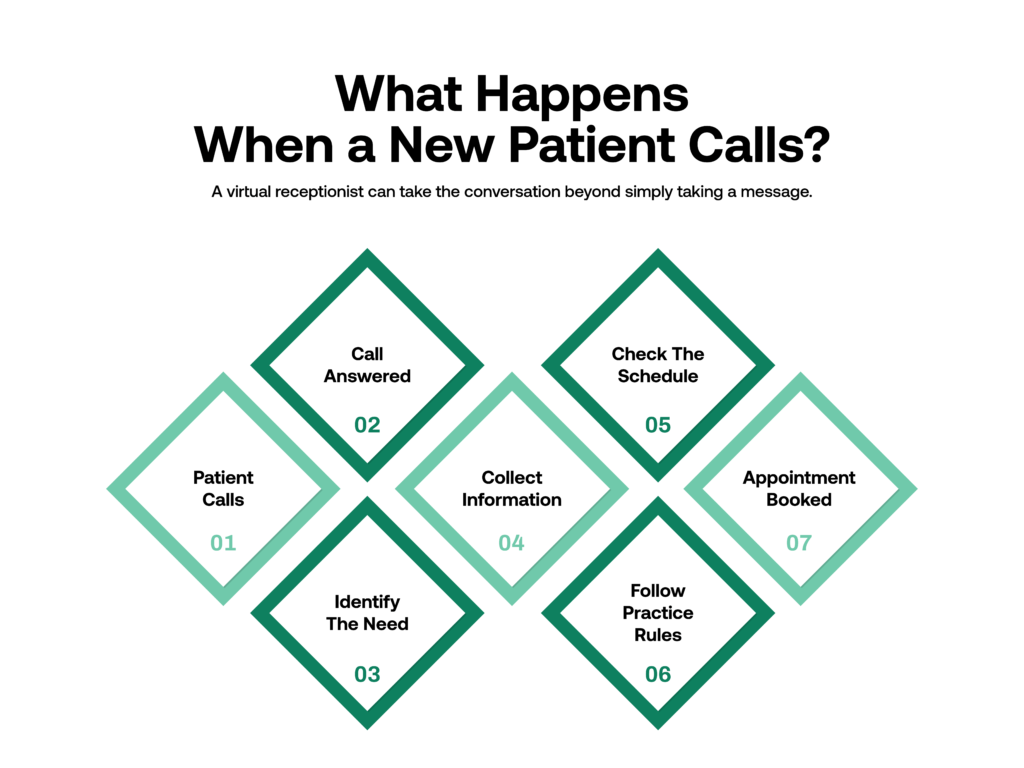
A medical receptionist does considerably more than answer the phone.
Depending on the practice, they may schedule appointments, verify insurance, handle referrals, coordinate with pharmacies, collect patient information, follow up on messages, communicate with providers, manage cancellations, and deal with patients who are confused, frustrated, anxious, or simply unsure who they need to speak with.
Some of these tasks are highly predictable.
Others aren’t.
That is the fundamental difference between AI and a human medical receptionist.
AI performs particularly well when the workflow is predictable. Humans become more valuable as the situation becomes less predictable.
For example, an AI medical receptionist can potentially handle:
- Appointment scheduling and rescheduling
- Basic patient intake
- Appointment reminders
- Call routing
- Straightforward new-patient requests
- Cancellations
- Office hours and location questions
- Frequently asked questions
- After-hours calls
But consider a patient who calls and says:
“I need to reschedule my appointment. Also, I’ve been having some problems since my procedure and I’m not sure what I’m supposed to do.”
The first request is administrative.
The second requires context and appropriate escalation.
A human receptionist can recognize that the conversation has changed. An AI system can potentially be designed to recognize it too, but that requires careful configuration, testing, escalation rules, and ongoing monitoring.
That distinction is easy to miss when comparing AI and human receptionists on a feature list.
Where an AI medical receptionist can genuinely outperform a human
Let’s give AI its due.
There are situations where automation makes a tremendous amount of sense.
1. Availability
A human receptionist cannot answer every call simultaneously.
They may be helping a patient at the front desk, already speaking to someone else, taking lunch, or simply away from the phone.
AI doesn’t have those limitations.
For practices receiving significant numbers of calls after hours or during busy periods, 24/7 availability can be a major advantage.
2. Repetitive conversations
If your front desk spends a significant portion of the day answering questions such as:
- “What time do you open?”
- “Where are you located?”
- “Can I reschedule?”
- “Do you have an appointment next week?”
- “What should I bring to my appointment?”
automation can take a considerable amount of repetitive work away from staff.
And physicians are increasingly interested in AI for precisely this reason. The American Medical Association’s 2026 physician survey found that 81% of physicians reported using AI professionally, while physicians continue to identify administrative burden and efficiency as important opportunities for AI.
3. Consistency
An AI receptionist can follow the same approved workflow every time.
It doesn’t forget an SOP because the office is busy.
It doesn’t decide to skip a question because it has already answered the same question 30 times that morning.
But there is an important catch:
AI is consistently wrong if you give it the wrong information or workflow.
That makes configuration and monitoring extremely important.
4. Handling call volume
A human receptionist can only have one conversation at a time.
AI can potentially handle multiple conversations simultaneously, making it attractive for high-volume practices, multi-location organizations, and practices that regularly experience call spikes.
That doesn’t necessarily mean AI should replace your receptionist.
It may simply mean your receptionist no longer needs to spend the day answering every routine call.
Where a human virtual medical receptionist still has the advantage
The biggest human advantage isn’t simply “empathy.”
It’s judgment.
A good medical receptionist learns how your practice works.
They learn which physician handles what.
They learn which scheduling rules matter.
They understand when a patient’s request doesn’t quite fit the normal process.
And, over time, they build familiarity with patients and the practice itself.
Humans handle exceptions better
Consider these situations:
“My insurance changed, but I don’t have the new card yet.”
“The doctor told me to call if this happened.”
“I can’t make the appointment because I have to take care of my mother.”
“I was told something different when I called last week.”
These aren’t necessarily complicated questions.
They’re context-heavy questions.
A human can ask another question, understand the situation, check with the appropriate person, and figure out what should happen next.
Humans can recognize frustration
Healthcare calls aren’t ordinary customer-service calls.
Patients may be scared about a diagnosis, frustrated about insurance, embarrassed about a condition, or worried because they cannot get an appointment.
A patient who has been on hold for ten minutes doesn’t necessarily want another automated interaction.
Sometimes they simply want someone to say:
“I understand. Let me see what I can do.”
That interaction can matter.
Research on healthcare communication has also shown that poor telephone interactions can place additional burden on patients, particularly when they aren’t given clear alternatives or next steps.
So while humans aren’t automatically better, a well-trained receptionist can provide something automation struggles with: situational understanding.
The biggest weakness of AI isn't that it sounds like a robot
Modern AI can sound remarkably natural.
That’s not necessarily the problem.
The bigger concern is when AI sounds confident while following the wrong workflow.
Imagine your practice changes its cancellation policy.
Or a physician changes their schedule.
Or you stop accepting a particular insurance plan.
Or certain appointment types become restricted.
A human receptionist can be told about the change and incorporate it into their work.
An AI system has to be updated.
That means AI isn’t really “set it and forget it.”
Someone at the practice needs to review how it is performing, update information, monitor unusual interactions, and make sure patients can reach a human when the situation falls outside the system’s capabilities.
The question isn’t just:
“How many calls can AI answer?”
A better question is:
“How many calls can AI handle correctly without creating more work for my staff?”
That is the metric that matters.
And humans have failure modes too!
It’s easy to romanticize the human receptionist.
But humans make mistakes.
They can:
- Miss calls
- Forget callbacks
- Enter incorrect appointment information
- Give inconsistent answers
- Put patients on hold
- Become overwhelmed during call spikes
- Call in sick
- Leave the practice
A human receptionist may also spend hours every day answering questions that require almost no judgment.
So the goal shouldn’t be to prove that humans are better than AI.
Neither is perfect. They simply fail differently.
AI may struggle with unusual situations.
Humans may struggle with volume, consistency and repetitive work.
The right choice depends on which problem is hurting your practice more.
What about a hybrid human + AI receptionist model?
For many practices, this is where the conversation gets more interesting.
Instead of asking AI or a human receptionist to handle everything, you can divide the work.
For example
AI handles
- Routine appointment scheduling
- Cancellations and rescheduling
- Basic FAQs
- Office information
- Appointment reminders
- Simple intake
- After-hours calls
- Call routing
A human receptionist handles
- Complex scheduling
- Difficult or frustrated callers
- Insurance-related conversations
- Unusual patient requests
- Follow-ups
- Coordination with staff
- Situations requiring judgment
Clinical staff handles
- Medical advice
- Symptoms
- Medication questions
- Test results
- Urgent clinical concerns
- Anything requiring clinical judgment
This can give a practice the best characteristics of both systems.
But there is a catch.
You are paying for two systems.
A hybrid model can mean paying for an AI platform, usage, integrations and maintenance while still paying for a human receptionist.
So hybrid doesn’t automatically mean cheaper.
It means you’re trying to make each resource do the work it is best suited for.
If AI eliminates enough repetitive work that your human receptionist can spend more time on insurance verification, referrals, patient follow-up, authorizations, and other valuable administrative tasks, the additional cost may be justified.
If AI simply creates another layer that your receptionist has to monitor and correct, it may not be.
Human Virtual Medical Receptionist vs. AI Receptionist
| Feature | Human Virtual Receptionist | AI Receptionist |
|---|---|---|
| Availability | Business hours / scheduled coverage | 24/7 |
| Patient Interaction | Personal, conversational | Automated, consistent |
| Complex Requests | Strong | Limited |
| Routine Calls | Good | Excellent |
| Judgment & Context | Strong | Limited |
| Call Volume | Limited by staffing | Highly scalable |
| After-Hours Coverage | Requires additional coverage | Built in |
| Patient Preference | Best for patients wanting a person | Best for patients comfortable with automation |
| Setup & Maintenance | Training + ongoing management | Configuration + ongoing monitoring |
| Best Suited For | Complex, relationship-driven practices | High-volume, repetitive workflows |
Availability
Human Virtual Receptionist
Business hours / scheduled coverage
AI Receptionist
24/7
Patient Interaction
Human Virtual Receptionist
Personal, conversational
AI Receptionist
Automated, consistent
Complex Requests
Human Virtual Receptionist
Strong
AI Receptionist
Limited
Routine Calls
Human Virtual Receptionist
Good
AI Receptionist
Excellent
Judgment & Context
Human Virtual Receptionist
Strong
AI Receptionist
Limited
Call Volume
Human Virtual Receptionist
Limited by staffing
AI Receptionist
Highly scalable
After-Hours Coverage
Human Virtual Receptionist
Requires additional coverage
AI Receptionist
Built in
Patient Preference
Human Virtual Receptionist
Best for patients wanting a person
AI Receptionist
Best for patients comfortable with automation
Setup & Maintenance
Human Virtual Receptionist
Training + ongoing management
AI Receptionist
Configuration + ongoing monitoring
Best Suited For
Human Virtual Receptionist
Complex, relationship-driven practices
AI Receptionist
High-volume, repetitive workflows
Don't forget the patient experience
This may be the most important consideration.
A technically impressive system isn’t necessarily a good patient-access system.
Some patients will happily schedule an appointment with AI at 10 PM.
Others will immediately ask:
“Can I speak to a person?”
Your practice needs to accommodate both.
The American Medical Association’s 2026 research found that physicians are increasingly comfortable using AI, but privacy, safety, liability, and protecting the physician-patient relationship remain significant concerns.
And research into AI-assisted outpatient reception suggests that AI can work particularly well when paired with human oversight rather than treated as a complete replacement for human communication. One randomized study found higher patient satisfaction with a nurse-AI collaboration model than with nurse-led reception alone.
That is an important distinction.
The future of healthcare reception may not be human versus AI. It may be human plus AI.
So, which is right for your medical practice?
There isn’t one answer.
A human virtual medical receptionist may be the better choice if:
- Your calls are frequently complex.
- Patients need significant assistance.
- Your specialty involves sensitive conversations.
- Scheduling requires judgment.
- Your patients strongly prefer human interaction.
- Your receptionist performs other important administrative work.
- Relationship and continuity are important to your practice.
An AI medical receptionist may make sense if:
- Your call volume is high.
- A large percentage of calls are repetitive.
- Missed calls are costing you appointments.
- You need after-hours coverage.
- Your scheduling workflow is relatively straightforward.
- Patients frequently ask the same questions.
- Your staff spends too much time handling routine calls.
A hybrid approach may be worth considering if:
- You have high call volume and complex calls.
- You want 24/7 availability.
- You want to reduce routine workload without removing human support.
- Your staff is overwhelmed.
- You have clear escalation rules.
- You are prepared to monitor and maintain the technology.
Before you choose, test your current front desk
Here’s something every practice can do before hiring anyone or buying any technology:
Call your own practice.
Call at 9 AM.
Call during lunch.
Call at 4:30 PM.
Call after hours.
Pretend you’re a new patient.
Then ask yourself:
- How long did it take to reach someone?
- Could I schedule an appointment?
- Could I get a clear answer?
- Did I have to repeat myself?
- Could I easily reach a human?
- What happened when my question didn't fit the normal workflow?
- Would I feel confident calling this practice again?
You may discover that your real problem isn’t that you need an AI receptionist or a human receptionist.
You may simply need to redesign how your practice handles calls.
The answer isn't “AI or human.” It's “which work needs which one?”
The conversation around AI medical receptionists has become unnecessarily binary.
AI isn’t going to magically eliminate every front-desk problem.
A human receptionist isn’t going to magically solve every patient-access problem either.
The smarter approach is to look at the work itself.
Predictable, repetitive, high-volume tasks are strong candidates for automation.
Complex, sensitive, judgment-heavy interactions are usually better suited to a human.
And when your practice has both types of work, a combination may make the most sense.
Just remember that the cheapest option on paper isn’t necessarily the least expensive option in practice.
A missed patient, a scheduling error, a frustrated caller, or an AI-generated mistake can cost considerably more than the monthly price of a receptionist.
The best solution is therefore not the one with the lowest hourly rate or the most impressive technology.
It’s the one that lets your patients get the right level of help, while allowing your staff to spend their time where human judgment actually matters.
That is ultimately what a good medical front desk should do—whether the person answering the phone is human, AI, or a combination of both.
FAQs
Frequently Asked Questions
A credible healthcare virtual receptionist provider should have a structured hiring, training, and quality-control process. Receptionists should understand professional patient communication, healthcare workflows, scheduling, and the practice's specific procedures before handling calls. The goal is for the receptionist to function as an extension of your front desk, not as a generic call-center agent.
Mistakes can happen with both in-house and virtual staff. The key is limiting them through clear SOPs, practice-specific training, and escalation procedures. Receptionists should know what they can answer and when they need to involve someone from the practice rather than guessing. Ongoing quality monitoring can also identify recurring errors before they become larger problems.
They shouldn't be expected to know it immediately. A professional service should have an onboarding process where the practice explains its scheduling rules, EHR workflows, communication preferences, and escalation procedures. The receptionist then learns the practice's way of doing things instead of relying on a generic script.
This is where working with an established provider can be more reliable than hiring an individual freelancer. A good service should have backup coverage and documented workflows so another trained receptionist can step in when necessary. The goal is to maintain continuity without making patients feel like they're starting from scratch every time someone is absent.
Yes, and this is one of the areas where a trained human can be particularly valuable. They can listen, ask questions, understand the situation, and determine what needs to happen next. They should also know when to escalate the issue rather than trying to solve something outside their role.
Absolutely, but only when they're properly integrated into the practice. A receptionist who understands your providers, scheduling preferences, workflows, and common patient requests can communicate far more naturally than a generic call-center agent. “Virtual” refers to where the receptionist works; it shouldn't mean they're disconnected from your practice.
Healthcare practices should look beyond a simple “HIPAA compliant” claim. Ask whether the provider will sign a BAA where required, how PHI is accessed and protected, what security controls are in place, and how employee access is managed. A credible healthcare-focused provider should have privacy and security built into its operating procedures.
You shouldn't have to guess. A professional provider should have clear performance expectations and quality-monitoring processes. Practices can track metrics such as calls handled, appointments scheduled, messages documented, follow-ups completed, and escalation accuracy. Regular feedback also helps correct problems before they affect the patient experience.
The first priority is correcting the mistake quickly and communicating with everyone affected. Beyond that, recurring errors should be investigated. Sometimes the problem is inadequate training; sometimes the practice's scheduling rules simply weren't clear enough. Good providers use feedback to improve the workflow rather than treating every mistake as an individual employee problem.
The first priority is correcting the mistake quickly and communicating with everyone affected. Beyond that, recurring errors should be investigated. Sometimes the problem is inadequate training; sometimes the practice's scheduling rules simply weren't clear enough. Good providers use feedback to improve the workflow rather than treating every mistake as an individual employee problem.
That's a reasonable concern for some practices. Location matters less when the receptionist communicates clearly, understands U.S. healthcare workflows, and represents the practice professionally. Practices should also be transparent about where their virtual team is located rather than pretending otherwise. Ultimately, the patient experience should be the deciding factor.
Some practices have straightforward workflows; others don't. A good provider should allow for practice-specific onboarding and feedback as the receptionist learns the system. If problems continue, the provider should determine whether the issue is training, unclear procedures, or simply a poor fit, and be prepared to make a change when necessary.
Not automatically. AI can be excellent for repetitive, predictable interactions, while humans tend to be more useful when conversations require judgment, context, or flexibility. For some practices, a combination makes the most sense. The right choice depends on what your patients call about and how complicated your front-desk workflows are.
Ask what they understand beyond simply answering phones. A healthcare-focused provider should be familiar with EHRs, patient scheduling, HIPAA, PHI, referrals, insurance workflows, patient intake, and escalation procedures. Also, ask how receptionists are trained, monitored, and replaced if they aren't a good fit. Their answers will tell you more than the word “healthcare” on their website.
Don't make price your only question. Ask about training, HIPAA and BAAs, EHR access, backup coverage, quality control, onboarding, escalation procedures, and what happens if the assigned receptionist isn't a good fit. These details tell you how the service actually operates and ultimately matter more than a low hourly rate.
Table of Contents
- Key Takeaways
- Human and AI receptionists solve different front-desk needs
- AI excels at routine, predictable, high-volume calls
- Human receptionists provide stronger judgment and handle complex situations
- A hybrid human + AI model can combine automation with human support
- Patient experience should be a key factor when choosing a receptionist solution
- The best approach matches each front-desk task with the right resource
- Share This Article
Your Patients Need More Than Automation
AI can handle routine calls, but complex patient conversations often need human judgment. Get a trained virtual medical receptionist to support your front desk and patient experience.